

A Practical Guide to Eliminating Foods That Cause Persistent Gas
A Practical Elimination Diet for Gas and Bloating
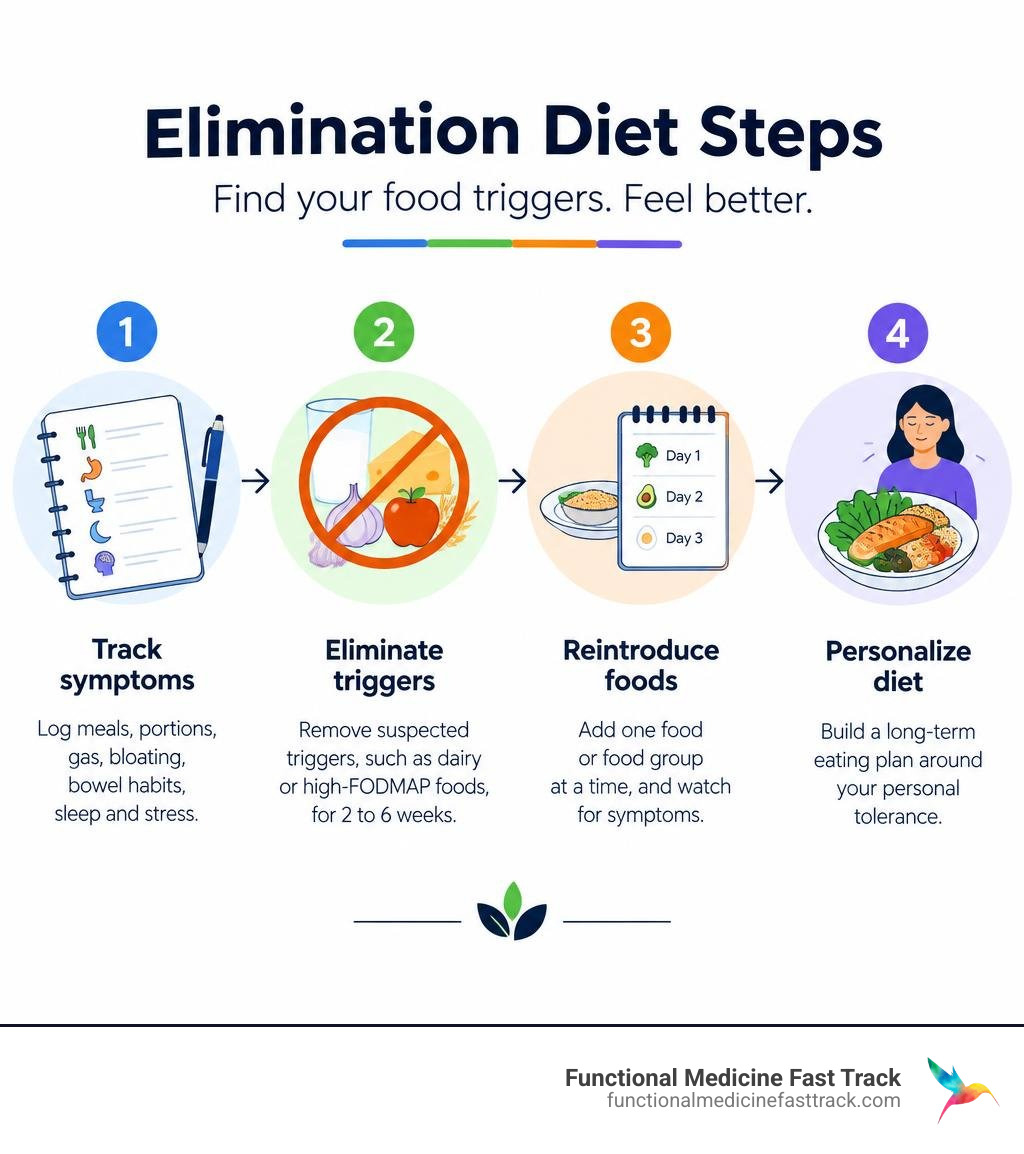
An elimination diet for gas and bloating is a short-term, structured way to find foods that worsen symptoms. Remove likely triggers for a defined period, keep a daily symptom log, then add foods back one at a time to see what changes.
Track meals, portions, gas, bloating, bowel habits, sleep, and stress for a few days.
Remove a focused set of suspected triggers, such as dairy or high-FODMAP foods, for 2 to 6 weeks.
Reintroduce one food or food group at a time, allowing about 3 days to watch for symptoms.
Build a long-term eating plan around your personal tolerance, not permanent blanket restriction.
For people with IBS-type symptoms, a low-FODMAP protocol is one evidence-based option. These fermentable carbohydrates can pull water into the gut and feed bacterial fermentation, which may increase gas and abdominal swelling. Research suggests low-FODMAP diets reduce symptoms for many people with IBS, but they are not meant to be followed strictly forever.
This process is not a substitute for medical evaluation. Severe pain, blood in the stool, vomiting, unexplained weight loss, or major bowel-habit changes need clinical attention before dietary experimentation.
I am Garric Vosloo, a functional medicine practitioner with more than 30 years of patient-care and practice experience. I have helped healthcare professionals apply structured approaches, including an elimination diet for gas and bloating, within individualized functional medicine care.
Understanding Food Triggers: Allergies, Intolerances, and Sensitivities
When your abdomen feels like an over-inflated balloon after lunch, it is tempting to blame the last bite you took. However, digestive distress stems from distinct physiological pathways. Understanding whether your reaction involves an immune response, an enzyme deficit, or bacterial activity helps determine how to address it.
Distinguishing Food Allergy vs Intolerance vs Sensitivity
Patients often use the terms allergy, intolerance, and sensitivity interchangeably, but they represent entirely different biological events:
Food Allergy: An immune-mediated reaction, typically involving Immunoglobulin E (IgE) antibodies. It triggers immediate, potentially life-threatening responses such as anaphylaxis, hives, facial swelling, or severe wheezing. Food allergies affect roughly 3% to 4% of adults and up to 6% of children.
Food Intolerance: A non-immunological breakdown failure, usually caused by an enzyme deficiency. Lactase deficiency is a classic example: without adequate lactase enzymes in the brush border of the small intestine, lactose cannot be broken down, leaving it to ferment downstream.
Food Sensitivity: A non-IgE immune-mediated or inflammatory reaction (often involving IgG pathways or cell-mediated responses). Symptoms are frequently delayed by hours or days, causing systemic manifestations such as brain fog, joint discomfort, fatigue, and lower-grade digestive distress.
Feature | Food Allergy | Food Intolerance | Food Sensitivity |
|---|---|---|---|
Primary Mechanism | IgE-mediated immune activation | Enzyme deficit or chemical reaction | Non-IgE immune/inflammatory response |
Onset of Symptoms | Minutes to 2 hours | 30 minutes to a few hours | Delayed (hours to several days) |
Severity | Mild to life-threatening | Uncomfortable; dose-dependent | Chronic, uncomfortable, systemic |
Common Examples | Peanuts, shellfish, tree nuts | Lactose (dairy), histamine, sulfites | Non-celiac gluten sensitivity, soy, corn |
Primary Diagnostic Tool | Skin prick, serum specific-IgE | Hydrogen breath tests, elimination | Structured elimination and challenge |
For conditions like celiac disease—an autoimmune reaction triggered by gluten that affects roughly 1.4% of the global population on serological testing—formal medical screening should always occur before eliminating gluten. As outlined in the StatPearls clinical review on elimination diets, structured dietary elimination remains the clinical standard for identifying non-IgE adverse food reactions.
The Mechanism of Fermentation and Intestinal Gas
Persistent gas is primarily a byproduct of microbial metabolism. When dietary carbohydrates pass through the upper gastrointestinal tract without complete enzymatic digestion or absorption, they arrive in the large intestine intact.
Here, resident microbes ferment these fermentable substrates into short-chain fatty acids (SCFAs), alongside gases such as hydrogen ($H2$), carbon dioxide ($CO2$), and methane ($CH_4$).

When gut dysbiosis is present—or when bacteria migrate upward into the small intestine (Small Intestinal Bacterial Overgrowth, or SIBO)—fermentation happens prematurely. This rapid gas production stretches the intestinal walls. In individuals with visceral hypersensitivity, even normal volumes of gas can register as severe pressure, cramping, and visible abdominal distension.
How to Execute a 3-Phase Elimination Diet for Gas and Bloating
Embarking on an elimination protocol requires a structured, step-by-step strategy. Implementing a structured elimination diet program helps systematically calm gut inflammation, reset the mucosal barrier, and clarify specific dietary triggers.
Phase 1: Planning the Elimination Diet for Gas and Bloating
The elimination phase lasts 3 to 6 weeks. A 21-day minimum is recommended in functional medicine because it aligns with the biological half-life of circulating IgG antibodies and provides multiple cycles of intestinal epithelial turnover (which occurs every 2 to 4 days).

Before beginning, review our comprehensive elimination diet food list to stock your kitchen with safe alternatives.
Primary Foods to Remove During Phase 1:
Dairy Products: Milk, cream, cheese, butter, and yogurt (removes lactose and casein).
Gluten-Containing Grains: Wheat, barley, rye, spelt, and triticale.
Soy and Corn: Tofu, edamame, soy sauce, cornmeal, high-fructose corn syrup.
Eggs: Both whites and yolks.
High-Risk Gas Producers: Legumes (beans, lentils), refined sugars, artificial sweeteners (sorbitol, xylitol, erythritol), carbonated beverages, alcohol, and caffeine.
Focus your meals around clean animal proteins (grass-fed meats, poultry, wild-caught fish), non-starchy vegetables, healthy fats (olive oil, avocado, coconut oil), and gluten-free complex carbohydrates like sweet potatoes and quinoa.
Phase 2: Systematic Reintroduction and Symptom Logging
Reintroduction is the diagnostic core of the protocol. Do not skip this phase or rush it by adding multiple foods back simultaneously. Follow our detailed elimination diet online guide for daily challenge templates.
Pick One Food: Choose a single ingredient from one eliminated group (e.g., pure sheep's milk yogurt for dairy, or plain cooked lentils for legumes).
Test in Titrated Portions: Consume a small portion (e.g., 1–2 teaspoons) at breakfast. If no immediate symptoms occur, eat a medium portion at lunch and a normal serving with dinner.
Observe for 3 Days: Return immediately to the baseline elimination diet for 72 hours. Do not introduce any other new foods during this window.
Log Everything: Monitor your digestion, energy, skin, mood, and sleep. Delayed reactions often surface 24 to 48 hours later.
Evaluate: If symptoms return, record the food as a trigger and eliminate it again until you are symptom-free. If no symptoms arise, that food is tolerated and can be incorporated into your rotation.
Phase 3: Long-Term Custom Maintenance and Gut Healing
The end goal of an elimination protocol is the broadest, most nutrient-dense diet your body can comfortably tolerate. Long-term restriction reduces microbial diversity and can cause unnecessary psychological stress.
Recognizing the link between elimination diets and anxiety is critical; chronic stress alters gut motility and heightens visceral pain perception via the gut-brain axis. Once trigger thresholds are established, focus on mucosal repair with restorative nutrients (like zinc carnosine, L-glutamine, and polyphenol-rich berries) to rebuild intestinal barrier integrity and re-expand your dietary variety over time.
Low-FODMAP and Target Protocols for Digestive Distress
When generalized elimination protocols do not fully resolve lower abdominal bloating and excessive flatulence, a carbohydrate-targeted intervention may be necessary.
Implementing a Low-FODMAP Elimination Diet for Gas and Bloating
FODMAP is an acronym for Fermentable Oligosaccharides, Disaccharides, Monosaccharides, And Polyols. These short-chain carbohydrates are poorly absorbed in the small intestine, drawing excess fluid into the bowel lumen and fermenting rapidly in the colon.
Oligosaccharides: Fructans and galacto-oligosaccharides (GOS) found in wheat, onions, garlic, and legumes.
Disaccharides: Lactose found in milk and soft cheeses.
Monosaccharides: Excess fructose found in honey, apples, and high-fructose corn syrup.
Polyols: Sugar alcohols like sorbitol and mannitol found in stone fruits and artificial sweeteners.
Research published across multiple gastroenterology cohorts shows that a structured low-FODMAP protocol reduces symptoms in 50% to 86% of individuals with Irritable Bowel Syndrome (IBS). As described in the Medical News Today guide to IBS elimination diets, the protocol involves a 2 to 6-week strict reduction followed by systematic single-carbohydrate challenges.
Fast Tract and Carbohydrate Fermentation Strategies
For individuals experiencing persistent upper digestive distension, reflux, or SIBO, evaluating total carbohydrate fermentation potential provides an alternative approach.
Consult the Fast Tract diet food list to understand how the glycemic index and fiber profiles of specific foods influence gas production. By identifying and temporarily reducing high-fermentation foods from the Fast Tract foods to avoid category—such as resistant starches and specific soluble fibers—you can decrease microbial fuel in the upper small intestine while maintaining overall dietary variety.
Best Practices, Safety Guidelines, and Mistakes to Avoid
A poorly planned elimination diet can lead to frustration, nutrient gaps, and food fear. Following clinical recommendations—such as those outlined in the UW-Madison integrative handout on elimination protocols—ensures the process remains safe and effective.
Essential Food and Symptom Journaling Strategies
Reliable data is essential when identifying triggers. Your food log should capture more than just what you ate:
Meal Composition & Timing: Include cooking methods (e.g., raw vs. steamed garlic or onions).
Bristol Stool Form: Track daily bowel movements from Type 1 (hard lumps) to Type 7 (entirely liquid).
Severity Ratings: Grade bloating, abdominal pain, and gas volume on a scale of 0 to 10.
Transit Time: Note when meals are eaten relative to symptom onset.
Confounding Variables: Record sleep quality, emotional stress, physical activity, and menstrual cycle phase.
Avoiding Nutritional Deficiencies and Over-Restriction
Eliminating entire food categories requires proactive nutrient replacement:
Calcium: If removing dairy, consume canned sardines with bones, fortified unsweetened almond milk, bok choy, and sesame seeds.
Prebiotic Fiber: Avoid remaining on ultra-low carbohydrate or zero-FODMAP diets for extended periods; long-term restriction can deplete protective Bifidobacteria and compromise colonocyte health.
Energy Balance: Ensure adequate caloric intake by increasing healthy fats (olive oil, coconut cream, macadamia nuts) to prevent unintended weight loss.
Caution: Anyone with an active or past history of an eating disorder or orthorexia should avoid restrictive elimination protocols without direct psychiatric and nutritional supervision.
When to Consult a Medical Practitioner
Dietary changes should not delay necessary medical investigations. Seek immediate clinical care if your bloating or abdominal distress is accompanied by "red flag" symptoms:
Unexplained, rapid weight loss
Visible blood in the stool or black, tarry bowel movements
Persistent nocturnal pain or diarrhea that wakes you from sleep
Unexplained iron-deficiency anemia
Progressive difficulty swallowing (dysphagia) or frequent vomiting
New onset of persistent symptoms in individuals over 50 years of age
Frequently Asked Questions About Food Elimination Protocols
How long does it take to see improvements in gas and bloating?
Most people notice a meaningful reduction in abdominal distension and gas within 10 to 14 days of strict elimination. By day 21, systemic inflammation drops and the epithelial lining has completed multiple turnover cycles, establishing a clean baseline for reintroduction.
What should I do if my symptoms do not improve after elimination?
If 4 to 6 weeks of strict dietary elimination yield no improvement, your symptoms are likely driven by non-dietary factors. Consider clinical testing for SIBO via lactulose breath testing, stool testing for fungal overgrowth (Candida), evaluation for exocrine pancreatic insufficiency (EPI), or screening for abdominophrenic dyssynergia (a coordination issue between the diaphragm and abdominal wall).
Can I retest problematic foods after a few months?
Yes. Food intolerances and non-celiac sensitivities are dynamic. After 3 to 6 months of targeted gut healing—focusing on microbiome diversification, mucosal repair, and stress management—many people can reintroduce previously problematic foods in moderate amounts without triggering symptoms.
Conclusion
Navigating chronic digestive distress does not require living on a permanently restrictive diet. By systematically removing potential triggers, observing your body's feedback, and methodically reintroducing foods, you can pinpoint the exact causes of your gas and bloating.
To download our complete clinical protocols, meal templates, and printable reintroduction logs, access the comprehensive Functional Medicine Fast Track Elimination Diet Food Plan Guide to begin your structured path toward lasting gut health.