

Pinpoint Hidden Food Sensitivities Using the IFM Reintroduction Tracker
Understanding the IFM Elimination Diet and Non-IgE Food Triggers
An IFM elimination diet symptom tracker is a clinical instrument used to pinpoint hidden food sensitivities by establishing baseline Medical Symptoms Questionnaire (MSQ) scores, logging multi-system symptoms during a 21-day elimination phase, and tracking delayed reactions across a 3-day observation window per reintroduced food.
Non-IgE-mediated food intolerances and sensitivities are estimated to affect 15% to 20% of the population. Unlike classic IgE-mediated food allergies—which trigger rapid, potentially life-threatening anaphylactic reactions—non-IgE food sensitivities typically involve delayed immune and inflammatory pathways. These reactions can take anywhere from a few hours to three days to surface, making them notoriously tricky to identify without a structured tracking system.
The elimination diet remains the gold standard diagnostic tool for identifying non-IgE, non-anaphylactic food sensitivities and intolerances. Rather than relying solely on laboratory panels that may show variable clinical utility, this protocol directly assesses how an individual’s physiology responds to the removal and controlled return of specific foods.
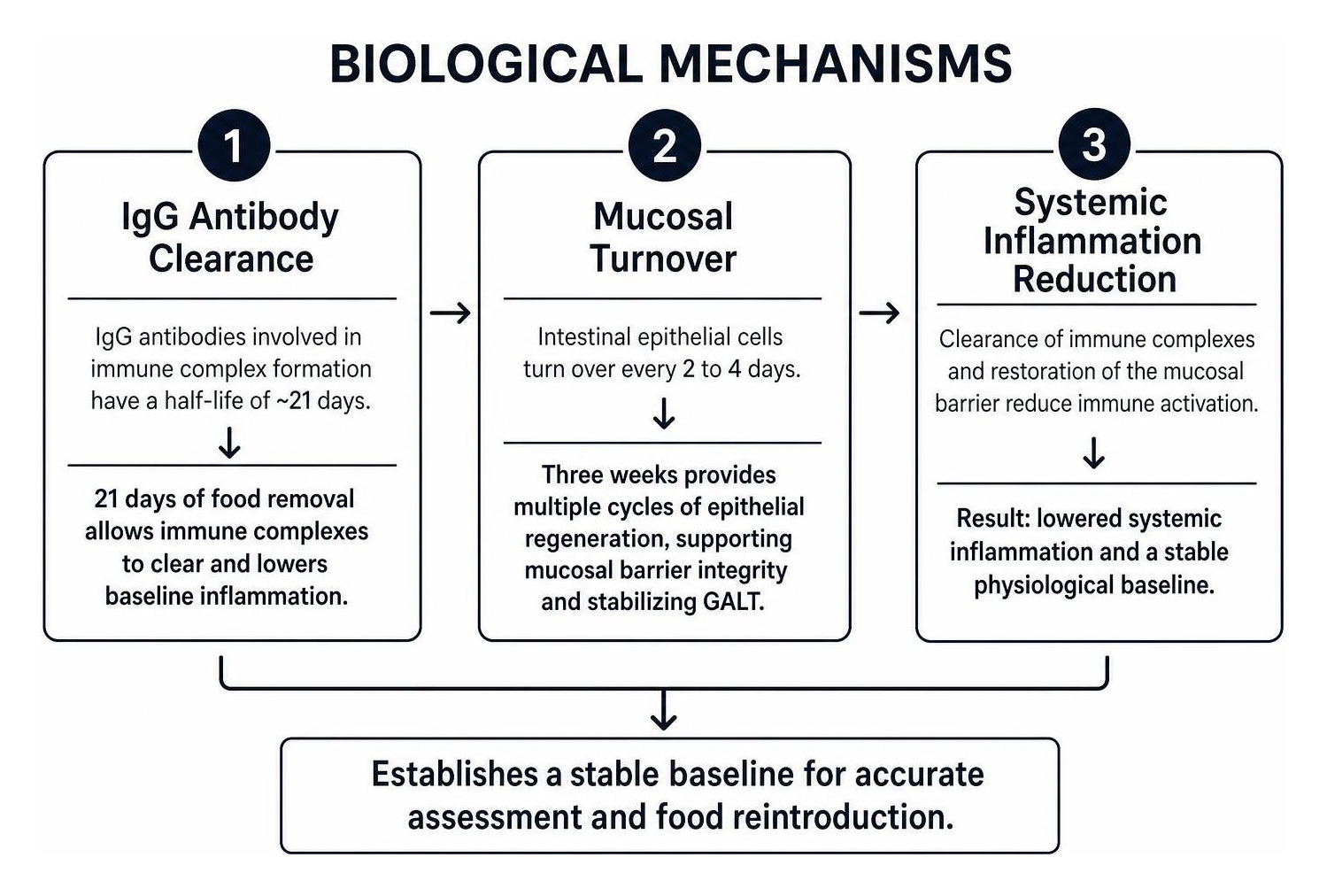
The physiological rationale behind the standard 21-day elimination timeline rests on two primary biological mechanisms:
IgG Antibody Half-Life: Circulating immunoglobulins (such as IgG antibodies involved in immune complex formation) have a biological half-life of roughly 21 days. Removing antigenic foods for three full weeks allows these immune complexes to clear, lowering baseline systemic inflammation.
Enterocyte Turnover: The mucosal lining of the gastrointestinal tract undergoes rapid renewal, with intestinal epithelial cells turning over every 2 to 4 days. A 3-week window provides multiple cycles of epithelial regeneration in an environment free from dietary irritants, supporting mucosal barrier integrity (reducing "leaky gut") and stabilizing gut-associated lymphoid tissue (GALT), where over 70% of the immune system resides.
When underlying gut permeability and systemic inflammation subside, practitioners and patients establish a stable baseline. Clinicians often rely on clinical guidance on comprehensive elimination diets to structure this diagnostic baseline before testing individual food groups.
How to Set Up Your IFM Elimination Diet Symptom Tracker
A functional symptom tracker is more than a simple food diary; it is a clinical instrument designed to capture systemic patterns across multiple physiological nodes.
To set up an effective tracking workflow, begin by capturing a comprehensive baseline before removing any foods.
1. Establish the Baseline Assessment
Before initiating day 1 of dietary elimination, have the patient complete a validated questionnaire:
Medical Symptoms Questionnaire (MSQ): A comprehensive tool assessing symptom frequency and severity across physiological domains (head, eyes/ears, digestive tract, joints/muscles, energy, mind, and emotions).
PROMIS Global Health Scale: Useful for establishing baseline physical and mental health summary scores.
2. Configure Daily Logging Cadence
Daily logs during the 21-day elimination phase should be quick (2 to 3 minutes) but consistent. Structure entries to capture:
Meal Timestamps and Ingredients: Exact food items, preparation methods, and hidden ingredients (e.g., sauces, cooking oils).
Daily Compliance Rating: A subjective 0–10 scale rating adherence to the elimination protocol (where 10 indicates 100% adherence without accidental exposures).
Target Symptom Severity: Daily scoring (0 = none, 10 = severe) across key categories.
Confounding Lifestyle Factors: Sleep quality (hours/restfulness), perceived stress levels (0–10), physical exertion, and menstrual cycle phase (if applicable).
Core Tracking Metrics for Your IFM Elimination Diet Symptom Tracker
Food sensitivities rarely manifest solely in the digestive tract. An effective ifm elimination diet symptom tracker monitors a wide spectrum of physical, neurological, and emotional markers.
Symptom Category | Clinical Indicators to Monitor | Primary Observation Timeframe |
|---|---|---|
Gastrointestinal | Bloating, postprandial gas, abdominal cramping, reflux/heartburn, stool consistency (Bristol Stool Scale 1–7), bowel frequency | 30 minutes to 24 hours |
Dermatological | Eczema flare-ups, urticaria, pruritus, acne breakouts, flushing, periorbital puffiness | 2 to 48 hours |
Neurological & Mood | Brain fog, tension headaches, migraines, afternoon fatigue crashes, irritability, sudden anxiety spikes | 1 to 48 hours |
Musculoskeletal | Joint stiffness, symmetrical arthralgia, myalgia, fluid retention/swelling in extremities | 12 to 72 hours |
Respiratory / ENT | Sinus congestion, post-nasal drip, excessive throat clearing, dark under-eye circles ("allergic shiners") | 1 to 24 hours |
Systemic & Vital | Resting heart rate elevations (>10 bpm postprandial), insomnia, night sweats, daytime lethargy | Immediate to 72 hours |
Step-by-Step Guide to the 3-Week Elimination and Reintroduction Phases

Successfully uncovering reactive foods requires strict adherence to both phases of the protocol. Skipping steps or rushing the reintroduction process compromises data clarity.
Phase 1: 21-Day Elimination Protocol
During Phase 1, the goal is to remove the most common dietary antigens while flooding the body with nutrient-dense, anti-inflammatory whole foods.
Foods to Exclude:
Grains: Gluten-containing grains (wheat, rye, barley, spelt) and corn.
Dairy: All cow, goat, and sheep milk, cheese, butter, yogurt, and casein/whey protein isolates.
Proteins: Soy (tofu, tempeh, soy sauce, edamame), eggs, pork, processed cold cuts, and shellfish.
Legumes & Nuts: Peanuts and peanut butter (other legumes and tree nuts may be permitted depending on individual customization).
Additives & Beverages: Refined sugars, high-fructose corn syrup, artificial sweeteners, alcohol, and excessive caffeine.
Foods to Emphasize:
Vegetables: 8 to 12 servings daily of diverse, colorful produce across the phytonutrient spectrum (leafy greens, cruciferous varieties, root vegetables).
Clean Proteins: Wild-caught cold-water fish, pasture-raised poultry, grass-fed beef, lamb, and plant-based options like hemp or pea protein.
Healthy Fats: Extra virgin olive oil, avocado oil, coconut oil, unsweetened coconut milk, and safe seeds (chia, flax, pumpkin).
Gluten-Free Grains: Brown/wild rice, quinoa, millet, buckwheat, and amaranth.
To implement this phase smoothly, practitioners often provide clients with structured elimination diet food plans to eliminate guesswork around meal construction and grocery shopping.
Phase 2: Systematic Food Reintroduction Protocol

Reintroduction is the diagnostic core of the protocol. It must be conducted methodically: introduce one single food at a time, keeping all other dietary variables strictly within the elimination parameters.
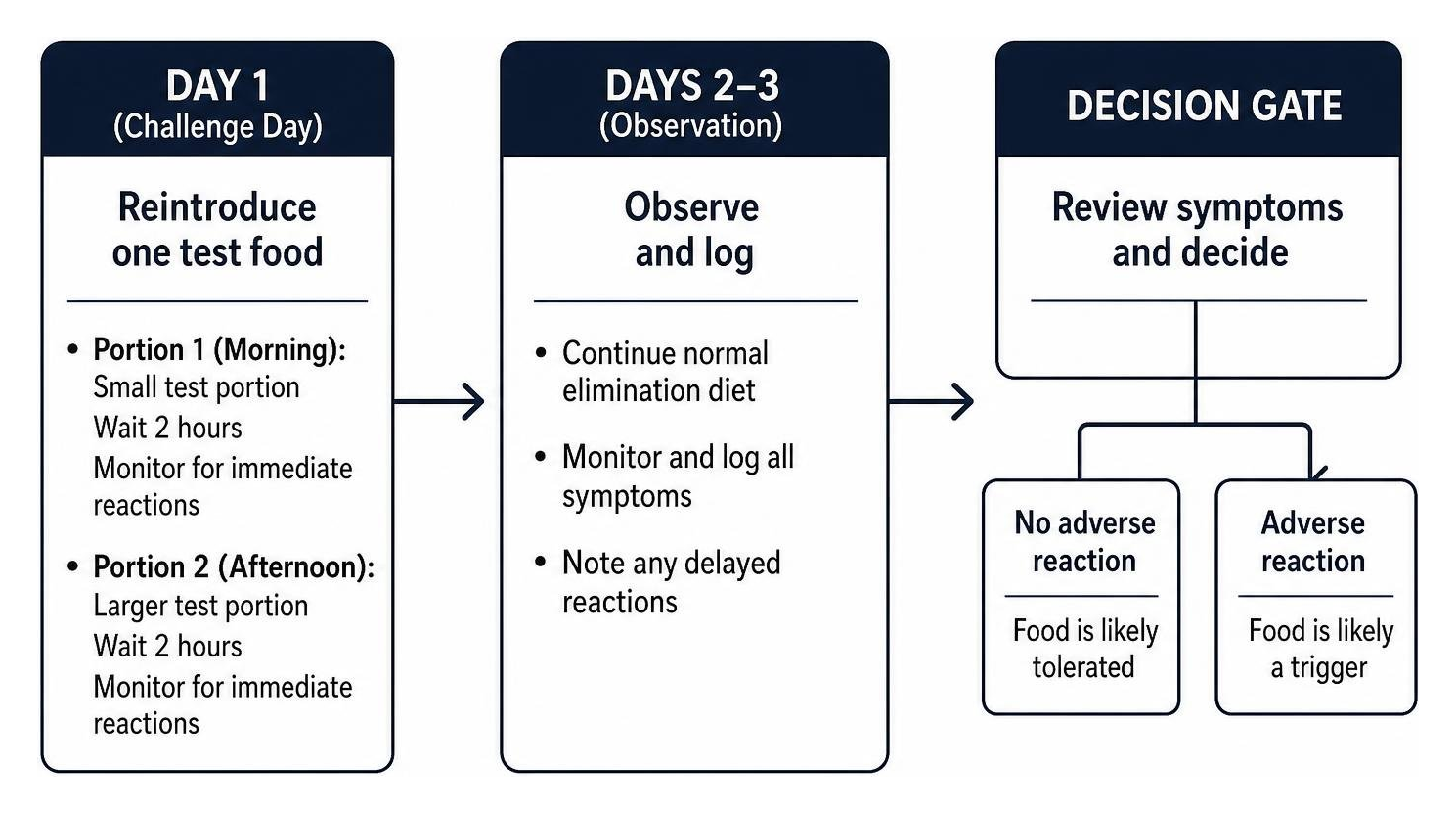
The 3-Day Challenge Protocol:
Day 1 (The Challenge Day):
Select a single, pure test food (e.g., pure organic plain yogurt for dairy, or organic whole wheat sourdough for gluten). Do not reintroduce complex combination foods (e.g., pizza contains gluten, dairy, nightshades, and additives simultaneously).
Portion 1 (Morning): Consume a small test portion (e.g., 1 teaspoon of yogurt or a few bites of wheat bread). Wait 2 hours while monitoring for immediate reactions.
Portion 2 (Lunch): If no immediate reaction occurs, consume a normal serving size.
Portion 3 (Dinner): Consume a final normal serving size with dinner.
Days 2 and 3 (The Observation Window):
Stop eating the test food completely. Return strictly to baseline Phase 1 elimination meals.
Log all physical, cognitive, and emotional markers in your symptom tracker. Watch closely for delayed reactions such as next-day joint stiffness, altered bowel habits, migraines, or skin flare-ups.
Evaluating the Outcome:
No Reaction: If Days 1, 2, and 3 are completely symptom-free, the food is considered tolerated. You may set it aside and proceed to challenge the next food category.
Reaction Detected: If a clear symptom flare occurs, record the food, the specific reaction, and severity in the tracker. Immediately revert to the elimination diet until symptoms fully resolve (typically 2 to 4 days) before initiating the next food challenge.
Maximizing Results with Health Coaching and Clinical Tools
Adhering to a strict dietary protocol and maintaining daily logs can be challenging for patients. Research demonstrates that integrating structured behavioral support significantly elevates clinical success.
A randomized controlled trial (RCT) evaluated the impact of functional medicine health coaching on dietary compliance and patient-reported outcomes among individuals undergoing an elimination diet protocol (D'Adamo et al., 2024).
The study revealed striking differences between groups:
Treatment Adherence: Participants paired with a functional medicine health coach reported significantly higher compliance scores (8.33 vs. 5.92 on a 0–10 scale, P <.0001) compared to the self-guided cohort.
Global Health Improvements: Both groups demonstrated statistically significant improvements in PROMIS Global Health scores. The coaching intervention group achieved a 4.68-point improvement in physical health and a 4.87-point improvement in mental health.
Symptom Burden Reductions: Medical Symptoms Questionnaire (MSQ) total scores dropped by 28.9 points in the coached group versus 24.1 points in the self-guided group.
Subgroup Impact: Among participants entering the study with higher baseline symptom severity, coaching produced a 3.90-point greater improvement in PROMIS Mental Health scores and a 12.3-point greater reduction in MSQ scores compared to self-guided controls.
These findings align with broader research on food elimination and symptom improvement, confirming that systematic food removal yields substantial quality-of-life gains, especially when executed with high adherence.
Integrating Coaching Support into Your IFM Elimination Diet Symptom Tracker
To translate these trial outcomes into everyday clinical practice, practitioners can combine structured symptom tracking with strategic coaching touchpoints:
Pre-Elimination Foundation Session: Review the tracker format, establish baseline MSQ/PROMIS scores, and create an environmental setup plan (pantry clean-out, batch cooking).
Mid-Elimination Check-in (Day 7–10): Audit the tracker for hidden compliance slips, navigate early withdrawal symptoms (e.g., caffeine or refined sugar cessation headaches), and reinforce positive dietary habits.
Reintroduction Strategy Session (Day 20): Plan the order of food challenges based on the patient's individual history and ensure they understand the 48-to-72-hour observation rule.
Post-Reintroduction Synthesis: Analyze logged symptom patterns together to design a sustainable, personalized long-term nutrition strategy.
Frequently Asked Questions About Elimination Diet Tracking
How long should I monitor for reactions after reintroducing a single food?
You should monitor for at least 48 to 72 hours. While immediate reactions (such as acute bloating or hives) can occur within 30 to 120 minutes, non-IgE-mediated responses, immune complex deposition, and mucosal inflammation often take up to 3 days to produce noticeable joint pain, skin flare-ups, mental fog, or bowel irregularities.
What is the difference between an IgE allergy and non-IgE food sensitivities?
An IgE-mediated food allergy triggers immediate mast cell degranulation and histamine release, posing severe risks like anaphylaxis, facial swelling, or acute wheezing.
A non-IgE food sensitivity or intolerance involves delayed immune pathways (such as IgG/IgA complexes or cell-mediated responses) or non-immunological mechanisms (such as enzyme deficiencies like lactase deficiency, which affects an estimated 25% to 90% of the population depending on ancestry). These reactions produce subacute, chronic symptoms across digestive, musculoskeletal, and neurological systems.
When should I re-test a food that caused a reaction during reintroduction?
Foods that trigger a clear reaction should be removed from your diet for a therapeutic window of 3 to 6 months. During this period, functional medicine strategies focus on repairing the gut mucosal barrier, rebalancing the microbiome, and reducing overall antigenic load. After 3 to 6 months of healing, the food can be systematically re-challenged using the same 3-day observation protocol to determine whether tolerance has been restored.
Conclusion
The IFM Elimination Diet is one of the most powerful diagnostic tools in clinical nutrition, but its success depends on meticulous data collection. Utilizing a structured symptom tracker transforms subjective patient experiences into actionable clinical insights, eliminating confusion during the reintroduction phase and pinpointing true inflammatory triggers.
At Functional Medicine Fast Track, we support licensed healthcare professionals in launching and scaling profitable functional medicine practices. By integrating clinical mentorship, streamlined patient education frameworks, and end-to-end practice management tools, we empower clinicians to deliver transformative dietary and lifestyle interventions under their own brand.
References
D'Adamo CR, Kaplan MB, Campbell PS, McLaughlin K, Swartz JS, Wattles KR, Lukaczer D, Scheinbaum S. "Functional medicine health coaching improved elimination diet compliance and patient-reported health outcomes: Results from a randomized controlled trial.." Medicine, 2024. PMCID PMC11309605.