

Beyond Conventional Care: A Functional Medicine Blueprint for Autoimmune Recovery
Why Functional Medicine for Autoimmune Disease Starts With Root Drivers
Functional medicine for autoimmune disease is a personalized, evidence-informed approach that works alongside specialist care. It looks for modifiable factors that may affect symptoms and disease activity, such as diet quality, nutrient status, sleep, stress, physical activity, gut symptoms, infections, and environmental exposures. The goal is not to replace DMARDs, biologics, or other prescribed treatment. It is to help patients reduce avoidable inflammatory burden and improve daily function through a structured, monitored plan.
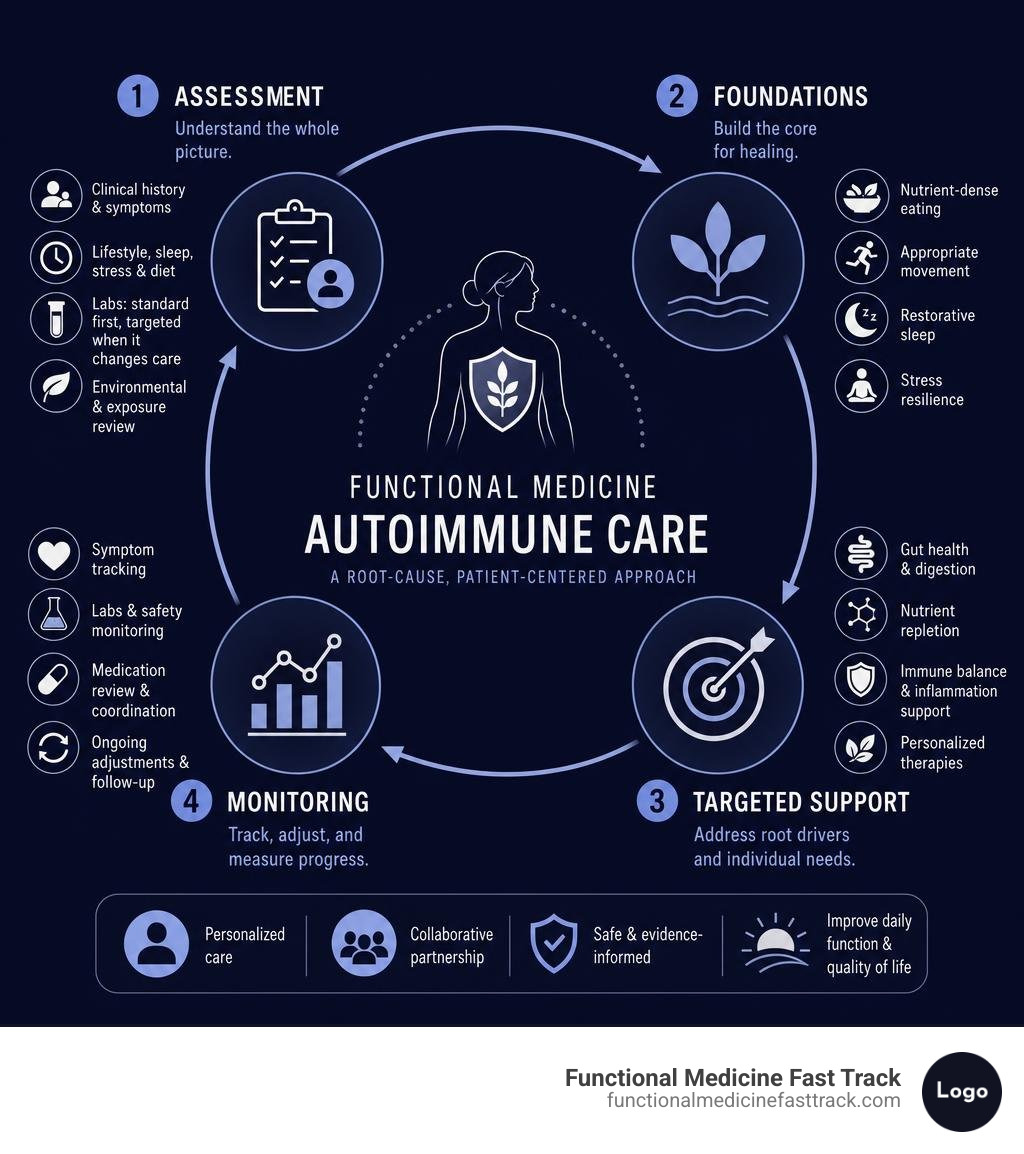
For clinicians, a practical starting point is to:
Confirm the diagnosis and establish co-management with the patient's rheumatologist or relevant specialist.
Review symptom timing, medications, diet, sleep, stress, hormonal transitions, and exposure history.
Use standard labs first, then order targeted testing only when it can change care.
Build foundations: a nutrient-dense eating pattern, appropriate movement, restorative sleep, and stress support.
Track symptoms, safety markers, and medication-related risks over time.
Autoimmune diseases occur when immune tolerance breaks down and the immune system attacks the body's own tissues. More than 80 conditions have been identified, from rheumatoid arthritis and lupus to Hashimoto's thyroiditis, multiple sclerosis, psoriasis, and inflammatory bowel disease. They affect millions of Americans and disproportionately affect women.
The rise in autoimmune illness cannot be explained by genes alone. The often-cited Fasano Triad offers a useful clinical framework: genetic susceptibility, an environmental trigger, and increased intestinal permeability may interact to create conditions for immune dysregulation. It is a framework, not a diagnostic shortcut. Each patient needs condition-specific medical evaluation and careful follow-up.
This guide helps practitioners build a safe, repeatable care model that combines conventional treatment with realistic nutrition, lifestyle, gut-health, and complementary-care strategies.
Understanding the Modern Autoimmune Epidemic and Root Drivers
Autoimmune diseases now affect an estimated 1 in 5 Americans—representing roughly 50 million individuals across the United States, with an additional 8 million carrying circulating autoantibodies that place them at elevated risk. Globally, 3% to 5% of the population suffers from autoimmune pathology. The financial toll on healthcare infrastructure is equally staggering, costing over $100 billion annually in the US alone. Direct and indirect costs for a single condition, such as multiple sclerosis, exceeded $85.4 billion in recent economic analyses.
The rapid escalation of autoimmune incidence over recent decades cannot be attributed to genetic shifts alone. Epigenetic mechanisms, driven by modern lifestyle transformations, processed food diets, toxicant exposures, and altered microbiomes, are driving immune dysregulation.
When addressing chronic immune disorders, comparing symptom management with root-cause medicine highlights distinct clinical goals:
Feature | Conventional Symptom Suppression | Root-Cause Resolution |
|---|---|---|
Primary Goal | Suppress active flares, block inflammatory cytokines, blunt immune reactivity | Identify upstream triggers, restore self-tolerance, rebuild physiological balance |
Primary Interventions | NSAIDs, Corticosteroids, Synthetic/Biologic DMARDs, JAK inhibitors | Anti-inflammatory dietary patterns, gut barrier repair, microbiome modulation, toxin elimination |
Diagnostic Focus | Disease classification, tissue staging, organ pathology, standard antibody titers | Systems biology mapping, mucosal permeability, hidden infections, metabolic and adrenal profiling |
Long-Term Outcome | Ongoing symptom mitigation with recurring risks of immune suppression | Sustainable low disease activity or drug-free remission with optimized vitality |
Exploring Functional Medicine for Autoimmune Conditions helps clinicians understand how upstream drivers disrupt systemic immunity and create ongoing inflammation.

The Fasano Triad: Genetics, Triggers, and Leaky Gut
Autoimmune pathogenesis requires three distinct factors known as the Fasano Triad:
Genetic Susceptibility: Polygenic variants (such as specific HLA alleles) predispose the immune system to misidentify self-peptides, establishing baseline vulnerability.
Environmental Triggers: Infections (e.g., Epstein-Barr virus), environmental toxicants (heavy metals, mycotoxins), medication exposures, and chronic psychosocial stress trigger immune activation.
Intestinal Hyperpermeability (Leaky Gut): A breakdown of the intestinal barrier permits antigenic material to cross into systemic circulation.
The mucosal barrier is regulated by tight junction proteins. When the zonulin pathway is activated by dietary antigens (such as gliadin) or dysbiotic bacterial overgrowth, tight junction integrity dissolves. Undigested food proteins and lipopolysaccharides (LPS) leak into the lamina propria, where approximately 70% to 80% of the body's immune cells reside.
Through molecular mimicry, the immune system produces antibodies against these foreign antigens that cross-react with self-tissues, launching chronic autoimmune attacks.
The Microgenderome and Hormonal Transitions in Women
Approximately 80% to 85% of individuals diagnosed with autoimmune disease are women. This disparity stems from distinct biological and physiological mechanisms:
Genetic Factors: The X chromosome contains a dense concentration of immune-related genes. Incomplete X-chromosome inactivation in females can amplify immune responsiveness.
The Microgenderome: The bidirectional communication network between sex hormones, gut microbiota, and immune signaling is known as the microgenderome. Estrogen and progesterone modulate microbiome diversity, mucosal barrier integrity, and regulatory T-cell (Treg) differentiation.
Hormonal Windows of Vulnerability: Autoimmune onset and flares cluster around major hormonal shifts—puberty, pregnancy, the postpartum period, and the perimenopausal transition. Sharp drops in progesterone and fluctuations in estrogen during postpartum and perimenopause alter mucosal immunity, weaken the gut barrier, and provoke immune flare-ups.
Conventional Treatment Limitations and the Need for a New Paradigm
Conventional rheumatology relies heavily on pharmaceuticals designed to halt inflammatory destruction:
Non-Steroidal Anti-Inflammatory Drugs (NSAIDs): Mitigate acute pain but disrupt the gastric mucosa, promote intestinal permeability, and raise cardiovascular risks.
Corticosteroids: Provide fast relief during severe flares, yet long-term use leads to osteopenia, adrenal suppression, glycemic dysregulation, and tissue breakdown.
Disease-Modifying Antirheumatic Drugs (DMARDs) and Biologics: Synthetic DMARDs (like methotrexate) and biologic agents (TNF-alpha inhibitors, interleukin blockers) suppress targeted inflammatory cascades.
While these medications can be essential for preventing irreversible joint or organ damage, they carry notable trade-offs:
Immune Vulnerability: Suppressing central immune pathways increases susceptibility to severe opportunistic infections and certain malignancies.
Symptom Relapse: Because pharmaceutical interventions do not address upstream drivers (such as microbiome dysbiosis, hidden chronic infections, or environmental toxicants), flares frequently return if medications are tapered.
Progressive Drug Resistance: Patients often lose responsiveness to a given biologic over time, requiring escalation to stronger agents.
Functional medicine provides a complementary model. Rather than forcing lifelong, unchecked immune suppression, it reduces the overall antigenic burden on the immune system, making disease management safer and more sustainable.
Core Protocols of Functional Medicine for Autoimmune Disease

A functional medicine strategy applies systems biology to identify and resolve the unique drivers of immune dysregulation, paving the way for transformative patient results.
Functional Medicine for Autoimmune Disease: Advanced Diagnostics
Standard blood chemistry panels confirm disease activity, but functional medicine utilizes specialized testing to uncover hidden drivers:
Comprehensive Stool Analysis (GI-MAP / Gut Zoomer): Assesses microbial diversity, pathogenic bacteria, parasites, fungal overgrowth (Candida), secretory IgA (mucosal immunity), and beta-glucuronidase levels.
Intestinal Permeability Markers: Evaluates serum zonulin, occludin, and anti-LPS antibodies to quantify tight junction integrity and endotoxemia.
Environmental Toxicant and Heavy Metal Panels: Urinary toxic panels identify mycotoxins from hidden mold, organophosphates, and heavy metals (mercury, lead, arsenic) that disrupt immune signaling.
Viral Reactivation Panels: Screen for chronic viral triggers, including Epstein-Barr Virus (EBV), Cytomegalovirus (CMV), and Human Herpesvirus 6 (HHV-6), which drive molecular mimicry.
Adrenal and Neuroendocrine Testing: Salivary or urinary diurnal cortisol and DHEA profiles (e.g., DUTCH testing) evaluate Hypothalamic-Pituitary-Adrenal (HPA) axis dysfunction linked to chronic stress.
Expanded Autoantibody Arrays: Detect elevated autoantibodies years before clinical tissue destruction occurs, providing an early window for intervention.
Dietary Strategies and the 5R Gut Restoration Blueprint
Nutrition serves as a powerful lever for calming autoimmune reactivity. Two core therapeutic patterns are supported by clinical evidence:
The Mediterranean Diet: Rich in polyphenols, omega-3 fatty acids, and prebiotic fibers, this dietary approach lowers systemic inflammatory biomarkers (hs-CRP, IL-6) and improves joint mobility in conditions like rheumatoid arthritis.
The Autoimmune Protocol (AIP) Diet: A targeted elimination strategy that removes common immunological triggers—grains, legumes, nightshades, dairy, eggs, refined sugars, and food additives—for 30 to 90 days, followed by systematic reintroduction. Clinical studies demonstrate that AIP can induce mucosal healing and clinical remission in inflammatory bowel disease and improve symptoms in Hashimoto's thyroiditis.
To heal the gastrointestinal barrier, practitioners apply the evidence-based 5R Protocol:
Remove: Eliminate food triggers, chronic gastrointestinal pathogens (such as parasites, dysbiotic bacteria, and Candida overgrowth), and environmental toxicants.
Replace: Support proper digestion and nutrient breakdown with supplemental hydrochloric acid (HCl), digestive enzymes, and bile support where indicated.
Reinoculate: Restore beneficial microbial balance using targeted probiotics, prebiotics, and fermented or polyphenol-rich foods.
Repair: Provide foundational nutrients to regenerate the mucosal lining and tighten epithelial junctions, including L-glutamine, zinc carnosine, deglycyrrhizinated licorice (DGL), and short-chain fatty acids (SCFAs).
Rebalance: Address upstream lifestyle factors like nervous system regulation, restorative sleep, and emotional health that directly influence the gut-brain-immune axis.
Evidence-Based CAM Therapies and Lifestyle Interventions

Complementary and alternative medicine (CAM) therapies offer evidence-based support for immune balance, symptom management, and patient quality of life (Katrib et al., 2025).
Research highlights non-pharmacological therapies that modulate immune physiology:
Targeted Physical Activity: A 2021 meta-analysis confirmed that structured home-based physical activity significantly reduces pain, mitigates fatigue, and enhances functional capacity in autoimmune rheumatic diseases. For multiple sclerosis, regular exercise and aquatic therapy improve balance and motor function.
HPA Axis and Stress Regulation: Retrospective data reveal that up to 80% of autoimmune patients report severe psychological stress before disease onset. Chronic sympathetic activation drives neurogenic inflammation, compromises the gut lining, and suppresses regulatory T-cell activity. Incorporating breathwork, meditation, and biofeedback downregulates inflammatory cytokine production.
For deeper insights into integrative protocols, explore the educational articles on our blog.
Targeted Supplementation and Mind-Body Interventions
Targeted nutraceuticals modulate inflammatory pathways and support immune self-tolerance:
Vitamin D3 with K2: Vitamin D acts as a neuroregulatory hormone that promotes Treg differentiation and suppresses inflammatory Th17 cells. Large-scale trials (such as the VITAL study) show that vitamin D supplementation reduces autoimmune risk by approximately 22%.
Omega-3 Fatty Acids (EPA/DHA): Therapeutic doses (2–4 g daily) alter cell membrane phospholipid composition, lowering eicosanoid and inflammatory cytokine production. Research indicates that omega-3 supplementation yields up to a 70% improvement in tender joint counts in rheumatoid arthritis.
Curcumin (with Piperine or Phytosome Delivery): Downregulates NF-kB transcription, blunts TNF-alpha expression, and reduces oxidative stress in joint and connective tissues.
Glutathione and NAC: Boost master intracellular antioxidant pathways, promote hepatic detoxification, and defend mucosal cells against oxidative damage.
Low-Dose Naltrexone (LDN): Used off-label at doses between 1.5 mg and 4.5 mg, LDN induces a temporary opioid receptor blockade that upregulates endogenous endorphin production and dampens toll-like receptor 4 (TLR-4) signaling on microglia, curbing neuroinflammation.
Acupuncture and Yoga Therapy: Randomized clinical trials show that acupuncture reduces systemic pain in systemic lupus erythematosus (SLE) cohorts, while mind-body yoga practices improve emotional resilience, decrease fatigue, and enhance joint mobility.
Functional Medicine for Autoimmune Disease: Safe CAM Integration
Integrating CAM therapies with standard pharmacology requires clinical caution:
Herb-Drug Interactions: Botanicals can alter cytochrome P450 hepatic enzymes. High-dose curcumin, for instance, can enhance the anticoagulant effects of blood thinners, while certain immunostimulatory herbs (like Echinacea or high-dose ashwagandha) may theoretically interact with immunosuppressive regimens.
Organ Toxicity Prevention: Patients taking methotrexate or leflunomide require close monitoring of hepatic enzymes (AST/ALT) and renal markers prior to introducing high-dose botanicals.
Specialist Collaboration: Functional medicine strategies must complement, rather than disrupt, standard rheumatologic care. Medication tapers should only occur when objective inflammatory biomarkers, antibody panels, and imaging studies demonstrate stable clinical remission under medical supervision.
Frequently Asked Questions About Autoimmune Recovery
Can autoimmune disease truly go into remission?
Yes. While genetic predispositions remain unchanged, clinical and immunological remission is an achievable goal. Remission means normalizing inflammatory blood markers (hs-CRP, ESR), significantly reducing or clearing autoantibodies (such as TPO or ANA titers), resolving daily symptoms, and halting tissue damage. Many individuals maintain drug-free remission or manage their health with low-dose baseline therapies alongside ongoing lifestyle strategies.
How long does a functional medicine protocol take to work?
Most patients experience initial improvements in digestion, energy, sleep, and pain within 4 to 8 weeks of removing inflammatory triggers and beginning gut restoration. Measurable declines in circulating autoantibodies, tissue repair, and immune recalibration typically require 3 to 6 months of consistent intervention. Long-term cellular healing, microbiome stabilization, and lifestyle adaptation continue throughout the first year.
Is it safe to use functional medicine alongside conventional medications?
Yes. Functional medicine is designed to complement conventional specialist care. Addressing nutritional deficiencies, gut dysbiosis, sleep architecture, and stress physiology lightens the inflammatory load on the body. This collaborative approach enhances the efficacy of necessary medications, mitigates side effects, and provides the physiological stability needed for safe, physician-guided drug tapering over time.
Conclusion
Navigating autoimmune disease requires looking beyond acute symptom suppression to address the underlying drivers of immune dysfunction. By targeting the factors in the Fasano Triad—genetic expression, environmental triggers, and intestinal barrier integrity—functional medicine provides a clear, science-backed path toward sustainable recovery and renewed vitality.
Healthcare practitioners looking to deliver this level of root-cause care need a practical, scalable clinical framework. Discover how our integrated three-pillar system—combining clinical mentorship, turn-key marketing, and an all-in-one patient management platform—can help you discover how to launch your clinical practice and transform patient outcomes under your own brand.
References
Katrib M, Hamdan Z, Serhal J, Hayek F, Makarem N, Rida MA. "Beyond conventional care: exploring complementary and alternative medicine for autoimmune disorders.." Reumatologia, 2025. PMCID PMC12264723.